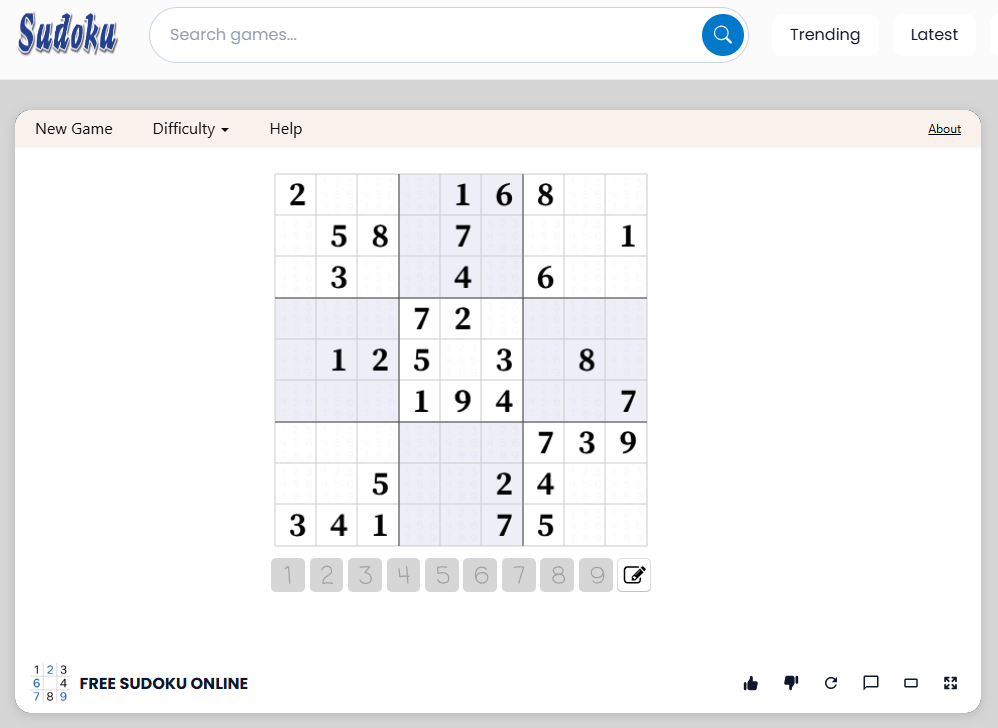

Sudoku is a popular number puzzle game that challenges players to use logic, concentration, and problem-solving skills. With simple rules and increasingly difficult challenges, Sudoku offers an enjoyable experience for beginners and experienced puzzle enthusiasts. The game does not require advanced mathematics or complicated calculations. Instead, players must analyze numbers, recognize patterns, and make logical decisions to complete a grid correctly.
The classic Sudoku puzzle features a 9x9 grid divided into nine smaller 3x3 boxes. Each row, column, and box must contain the numbers from 1 to 9 without repetition. Some numbers are provided at the beginning, while the remaining spaces must be filled through careful reasoning.
Sudoku has become a favorite activity for people around the world because it combines accessibility with intellectual challenges. Players can enjoy a quick puzzle during a break or spend more time solving advanced grids that require detailed analysis.
Understanding the basic rules is the first step toward enjoying Sudoku. Although the grid may appear complicated at first, the gameplay becomes easier once players understand how the numbers must be arranged.
A standard Sudoku board contains 81 cells arranged in nine rows and nine columns. These cells form nine smaller boxes, each containing nine spaces. Every row, column, and 3x3 box must include the numbers 1 through 9 exactly once.
The starting grid contains several fixed numbers that provide clues for solving the puzzle. Players must use these clues to determine which numbers belong in the empty cells. Repeating a number within the same row, column, or box breaks the rules and creates an incorrect solution.
To solve Sudoku, players should examine the available numbers before placing a digit in an empty cell. For example, if a row already contains the numbers 1, 2, 3, 4, 5, 6, 7, and 8, the only possible number for the remaining cell is 9.
More challenging situations require players to check several rows, columns, and boxes simultaneously. A number that appears possible in one area may be excluded by clues in another area. Careful observation helps players narrow down the options until a valid placement becomes clear.
Random guessing can make Sudoku more confusing, especially when a puzzle contains many empty cells. A better approach is to identify numbers that have only one possible position and complete those spaces first.
When no immediate answer is available, players can examine another section of the grid or use temporary notes to track possible candidates. This method keeps the solving process organized and reduces unnecessary mistakes.
Sudoku attracts players because it offers a simple format with almost unlimited opportunities for logical exploration. Every puzzle presents a different arrangement of clues, creating a fresh challenge even when the rules remain unchanged.
Sudoku encourages players to focus on details and evaluate information systematically. Each decision depends on the numbers already placed on the board, making concentration an important part of successful gameplay.
The puzzle also promotes logical thinking by requiring players to eliminate impossible options and identify valid solutions. Regular practice provides opportunities to develop more structured approaches to everyday problem-solving, although individual benefits may vary.
Many players enjoy Sudoku as a peaceful alternative to fast-paced games. The steady process of examining clues and completing cells can provide a satisfying activity during quiet moments.
Sudoku can be played alone without time pressure or competition. Players can choose an easy puzzle for a short break or attempt a difficult challenge when they want a more demanding mental activity.
Sudoku is accessible to children, adults, and older players who enjoy number-based puzzles. Beginners can start with grids containing many clues, while experienced players can explore puzzles that require advanced deduction techniques.
This flexible difficulty makes Sudoku suitable for different interests and experience levels. Players can gradually increase the challenge as they become more comfortable with the rules and common solving methods.
Developing effective solving habits can make Sudoku more enjoyable and help players avoid unnecessary mistakes. Instead of scanning the entire board without a clear plan, focus on specific areas and use the available clues efficiently.
Rows, columns, and boxes with several completed cells are often the best places to begin. Because fewer numbers are missing, the available possibilities are easier to identify.
Check which digits are absent from the selected area, then compare the empty cells against the surrounding rows and columns. This simple process often reveals numbers that can be placed immediately.
Scanning involves examining rows and columns to determine where a particular number can appear inside a 3x3 box. If existing numbers eliminate every position except one, that remaining cell must contain the target digit.
This technique is particularly useful when a puzzle seems difficult but still contains several obvious placements. Repeating the process with different numbers can gradually reveal more information across the board.
A naked single occurs when an empty cell has only one possible candidate. Once all other digits have been eliminated, the remaining candidate must be the correct answer.
A hidden single occurs when a number can fit in only one cell within a row, column, or box, even if that cell has other possible candidates. Learning to recognize these patterns can significantly improve solving efficiency.
Sudoku puzzles are commonly organized into difficulty levels to accommodate different abilities. Although exact classifications vary between platforms, most versions provide a gradual progression from simple grids to complex challenges.
Easy Sudoku puzzles usually provide more starting numbers and contain straightforward solutions. They help new players understand the grid structure, practice scanning, and become familiar with basic elimination techniques.
These puzzles are also useful for experienced players who want a short and comfortable challenge without spending too much time on a single board.
Medium Sudoku introduces situations that require more careful comparisons between rows, columns, and boxes. Players may need to track possible candidates before discovering the next correct number.
This level offers a useful balance between accessibility and complexity. It allows players to strengthen their reasoning skills while developing greater confidence in solving techniques.
Hard Sudoku puzzles contain fewer obvious placements and often require several logical steps before a number can be confirmed. Players may need to use candidate notes, advanced elimination, and more detailed pattern recognition.
Completing a difficult puzzle can be especially satisfying because each discovery depends on patience and consistent reasoning.
Online Sudoku makes it convenient to enjoy number puzzles on computers, tablets, and smartphones. Many platforms provide multiple difficulty settings, automatic error checking, note-taking tools, and fresh puzzles for regular practice.
Players can select a suitable challenge without installing complicated software or purchasing physical puzzle books. Depending on the platform, additional features may include timers, hints, statistics, and progress tracking.
For the best experience, choose a comfortable difficulty level and focus on understanding each placement rather than finishing as quickly as possible. Beginners can benefit from untimed games, while advanced players may enjoy testing their speed after developing reliable solving techniques.
Sudoku remains one of the most engaging number puzzle games because it combines straightforward rules with meaningful logical challenges. From learning the basic grid structure to mastering advanced solving techniques, every stage offers opportunities to practice concentration, patience, and analytical thinking.
Whether you prefer easy puzzles or demanding grids, Sudoku provides flexible entertainment for different skill levels. Start with a manageable challenge, study the available clues, and use logical elimination to fill every empty cell. With consistent practice, you can become more confident, solve puzzles more efficiently, and enjoy the rewarding experience of completing each Sudoku board.